
Hey there! As a wing pulley supplier, I often get asked about how to calculate the torque required for a wing pulley. It's a crucial aspect, especially when you're setting up a conveyor system. In this blog, I'll break down the process step by step, so you can make informed decisions when it comes to choosing the right wing pulley for your needs.
Understanding the Basics of Torque
Before we dive into the calculations, let's quickly go over what torque is. Torque is essentially a measure of the force that can cause an object to rotate around an axis. In the context of a wing pulley, it's the force needed to make the pulley turn and move the conveyor belt.

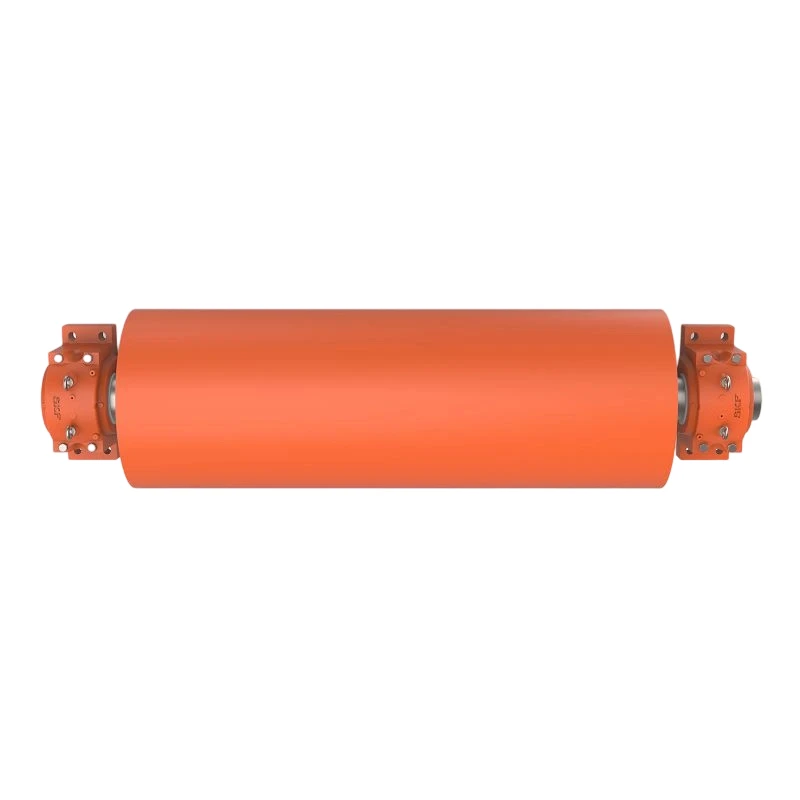
The formula for torque is pretty straightforward:
[ T = F \times r ]
Where:
- ( T ) is the torque (usually measured in Newton - meters, Nm)
- ( F ) is the force applied perpendicular to the radius
- ( r ) is the radius of the wing pulley
But in a real - world conveyor system, things get a bit more complicated. We need to consider several factors that affect the force ( F ).
Factors Affecting the Force on the Wing Pulley
Belt Tension
The tension in the conveyor belt is one of the primary factors that contribute to the force on the wing pulley. The belt tension can be divided into two main types: tight side tension ((T_1)) and slack side tension ((T_2)). The difference between these two tensions creates the driving force for the conveyor belt.
The formula for the net force ( F ) due to belt tension is:
[ F = T_1 - T_2 ]
To calculate (T_1) and (T_2), we need to consider factors like the weight of the conveyor belt, the load it's carrying, the friction between the belt and the pulley, and the angle of wrap of the belt around the pulley.
Friction
Friction plays a significant role in determining the belt tensions. The coefficient of friction ((\mu)) between the belt and the pulley surface affects how much force is transferred from the pulley to the belt. The relationship between (T_1) and (T_2) can be described by the Euler's formula:
[ \frac{T_1}{T_2}=e^{\mu\theta} ]
Where:
- ( e ) is the base of the natural logarithm (approximately 2.718)
- ( \mu ) is the coefficient of friction between the belt and the pulley
- ( \theta ) is the angle of wrap of the belt around the pulley in radians
Load on the Conveyor
The weight of the material being transported on the conveyor belt also adds to the force on the wing pulley. You need to know the mass per unit length of the load ((m_{load})) and the speed of the conveyor ((v)) to calculate the additional force due to the load.
Step - by - Step Calculation of Torque
Step 1: Determine the Belt Tensions
First, you need to estimate the slack side tension (T_2). This can be based on the minimum tension required to prevent the belt from slipping on the pulley. A common rule of thumb is to assume a certain minimum tension based on the type and size of the conveyor.
Once you have (T_2), you can calculate (T_1) using Euler's formula. For example, if you know the coefficient of friction (\mu = 0.3) and the angle of wrap (\theta=\pi) radians (180 degrees), then:
[ T_1=T_2\times e^{\mu\theta}=T_2\times e^{0.3\times\pi}\approx T_2\times 2.57 ]
Step 2: Calculate the Net Force
After getting (T_1) and (T_2), you can calculate the net force ( F = T_1 - T_2 ).
Step 3: Account for the Load on the Conveyor
If there's a load on the conveyor, you need to calculate the additional force due to the load. The force due to the load ((F_{load})) can be calculated using the formula:
[ F_{load}=m_{load}\times g\times L ]
Where:
- ( m_{load} ) is the mass per unit length of the load
- ( g ) is the acceleration due to gravity ((g = 9.81 m/s^2))
- ( L ) is the length of the conveyor
The total force ( F_{total}=F + F_{load} )
Step 4: Calculate the Torque
Finally, you can calculate the torque using the formula ( T = F_{total}\times r ), where ( r ) is the radius of the wing pulley.
Importance of Accurate Torque Calculation
Getting the torque calculation right is crucial for several reasons. If the torque is too low, the pulley won't be able to move the conveyor belt and the load effectively, leading to belt slippage and reduced efficiency. On the other hand, if the torque is too high, it can put unnecessary stress on the pulley, the motor, and other components of the conveyor system, leading to premature wear and tear and increased energy consumption.
Related Pulley Types
As a wing pulley supplier, I also deal with other types of pulleys that are commonly used in conveyor systems. For example, Belt Conveyor Smooth Pulley is often used in applications where a smooth surface is required for the belt to run on. Snub Pulleys are used to increase the angle of wrap of the belt around the drive pulley, which helps in increasing the friction and the driving force. Bend Pulleys are used to change the direction of the conveyor belt.
Conclusion
Calculating the torque required for a wing pulley is a multi - step process that involves considering factors like belt tension, friction, and the load on the conveyor. By following the steps outlined in this blog, you can make accurate calculations and choose the right wing pulley for your conveyor system.
If you're in the market for high - quality wing pulleys or have any questions about torque calculations or conveyor systems in general, don't hesitate to reach out. We're here to help you make the best decisions for your business. Let's start a conversation about your specific requirements and find the perfect solution together.
References
- Conveyor Handbook, Industry Standard Publication
- Engineering Mechanics: Statics and Dynamics textbooks


